
A learner may need only a small amount of individual help to move forward: an unfamiliar term explained, a missing step worked through, or a chance to ask the same question differently. For someone studying in a second language, an explanation in their home language may make the idea easier to discuss and understand.
This is a useful starting point for multilingual AI tutoring in Moodle. The opportunity is to make personalised support available during study, while the question is still relevant. Its educational value depends on whether that support helps learners develop understanding they can use for themselves.
Personalised help at the point of difficulty
Two learners can struggle with the same lesson for different reasons. One may be missing a prerequisite concept; another may understand the idea but be unfamiliar with its vocabulary. A useful tutor asks enough to identify the difficulty, then adjusts the explanation, example or hint.
That creates room to ask again without waiting for the next scheduled session. A learner can revisit an earlier idea, try an explanation in their own words and receive a follow-up question. Personalisation means responding to what the learner shows in the conversation; it does not require assigning them a fixed ability label.

There is evidence for this broader approach. A randomised study of the Mindspark programme in India found improvements in mathematics and Hindi after an after-school programme combining personalised software with instructor support. This was not a generative AI tutor. It supports the case for responsive teaching, while leaving the effectiveness of a particular AI implementation to be tested.
Home-language support can open another route to understanding
A learner may recognise the words on a page yet struggle to explain the concept behind them. Being able to discuss an example in a familiar language gives them another way to work through the meaning. They can then return to the terminology expected in the course or assessment.

The World Bank’s Loud and Clear report describes the barriers created when learners are taught in a language they do not understand well. It concerns language-of-instruction policy, rather than AI tutoring, but offers a relevant foundation for taking language seriously in learning support.
For a multilingual tutor, the practical aim is to connect familiar explanations with the subject language the learner needs. The course can retain its teaching and assessment language while learners ask questions, clarify meaning and practise reasoning in a language they choose. The quality of that exchange matters more than the length of a language menu.
What that support could look like
Imagine a learner working through compound interest in a financial literacy course. They understand that 10% of 1,000 is 100, but cannot see why two years of growth gives 1,210 rather than 1,200, assuming annual compounding and no other transactions. This is an illustrative teaching example.
A useful tutor could first ask which amount earns interest in the second year. If the learner is unsure, it could explain in their preferred language that the second calculation uses 1,100, including the first year’s interest. A small sketch of the two yearly balances could make that change visible. The tutor could then reconnect the explanation to the terms principal, interest and compounding.
The next step is for the learner to try a different starting amount and explain their reasoning independently. That gives a clearer indication of understanding than copying a completed calculation. Sometimes a direct explanation is needed; sometimes a hint is enough.
What the emerging AI evidence tells us
In a six-week randomised programme in Edo State, Nigeria, secondary-school learners received curriculum-aligned AI tutoring with teacher guidance. The researchers reported better assessment results for the programme group. Teachers introduced topics, guided the conversations and helped learners identify incorrect responses. The findings apply to that whole package; the study did not isolate the chatbot’s contribution or establish whether the benefits would last.
A high-school mathematics experiment in Türkiye shows why the design matters. Unrestricted AI help improved performance during practice, but learners performed worse when it was removed. A version using teacher-designed hints largely avoided that harm, although it did not produce a significant improvement on the independent test. Helping someone complete an exercise and helping them learn are different outcomes.
Together, these studies give useful design lessons: connect tutoring to the curriculum, support the learner’s reasoning and check what they can do without assistance. They are not evaluations of WebbLMS, and their findings should not be treated as forecasts for a different institution, age group or subject.
Make support part of the course
An explanation is easier to use when it refers to the example the learner is already studying. In Moodle, contextual tutoring can draw on permitted lesson content and course information, reducing the need for learners to reconstruct the question in a separate tool. Once WebbLMS is configured for the site, teachers do not need to write a separate context prompt for each lesson.
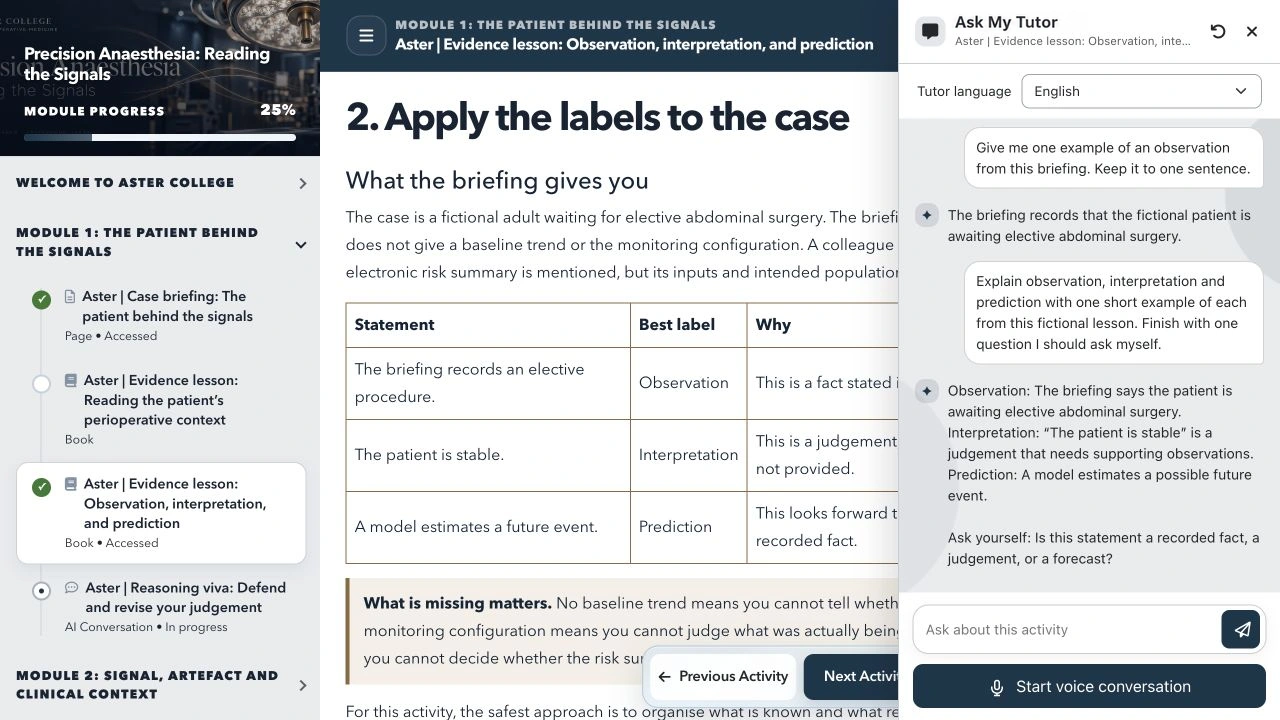
Multilingual chat and live conversation give learners different ways to seek that help. Typed conversation leaves time to compose a question and revisit the explanation. Voice can support a spoken back-and-forth, with a transcript to return to. A requested illustration can add another way to examine an idea. Learners should be able to choose the mode that suits their setting, including when connectivity, noise or privacy makes speaking difficult.
Help learners move forward
Start with a course where teachers know the recurring difficulties. Keep a clear route to a teacher when confusion persists, with staff retaining responsibility for assessment and academic judgement.
Ask fluent subject reviewers to check explanations, terminology, voice pronunciation and sketches. Make clear that AI can be wrong, and agree how learner conversations and data are handled. WebbLMS can restrict assessment interactions to navigation and progress support without sending assessment content for tutoring; verify that boundary in the assessments you use.
Then ask learners to explain an idea in their own words, apply it to a new example and recall it later without the tutor. Home-language support should help them understand the concept and use the course’s terminology. Usage and positive feedback matter, but independent learning is the test.

Explore the WebbLMS AI Tutor for Moodle, or talk to us about where your learners need support.
Research referenced
Muralidharan, K., Singh, A. and Ganimian, A. J. (2019). Disrupting Education? Experimental Evidence on Technology-Aided Instruction in India. American Economic Review, 109(4), 1426–1460.
World Bank (2021). Loud and Clear: Effective Language of Instruction Policies for Learning.
De Simone, M. E. and colleagues (2025). Addressing the learning crisis with generative AI: lessons from Edo State in Nigeria. World Bank; researcher-authored summary of the randomised programme.
Bastani, H. and colleagues (2025). Generative AI without guardrails can harm learning: Evidence from high school mathematics. Proceedings of the National Academy of Sciences, 122(26), e2422633122.